

Non-Surgical Facial Balancing in Clifton Park, NY
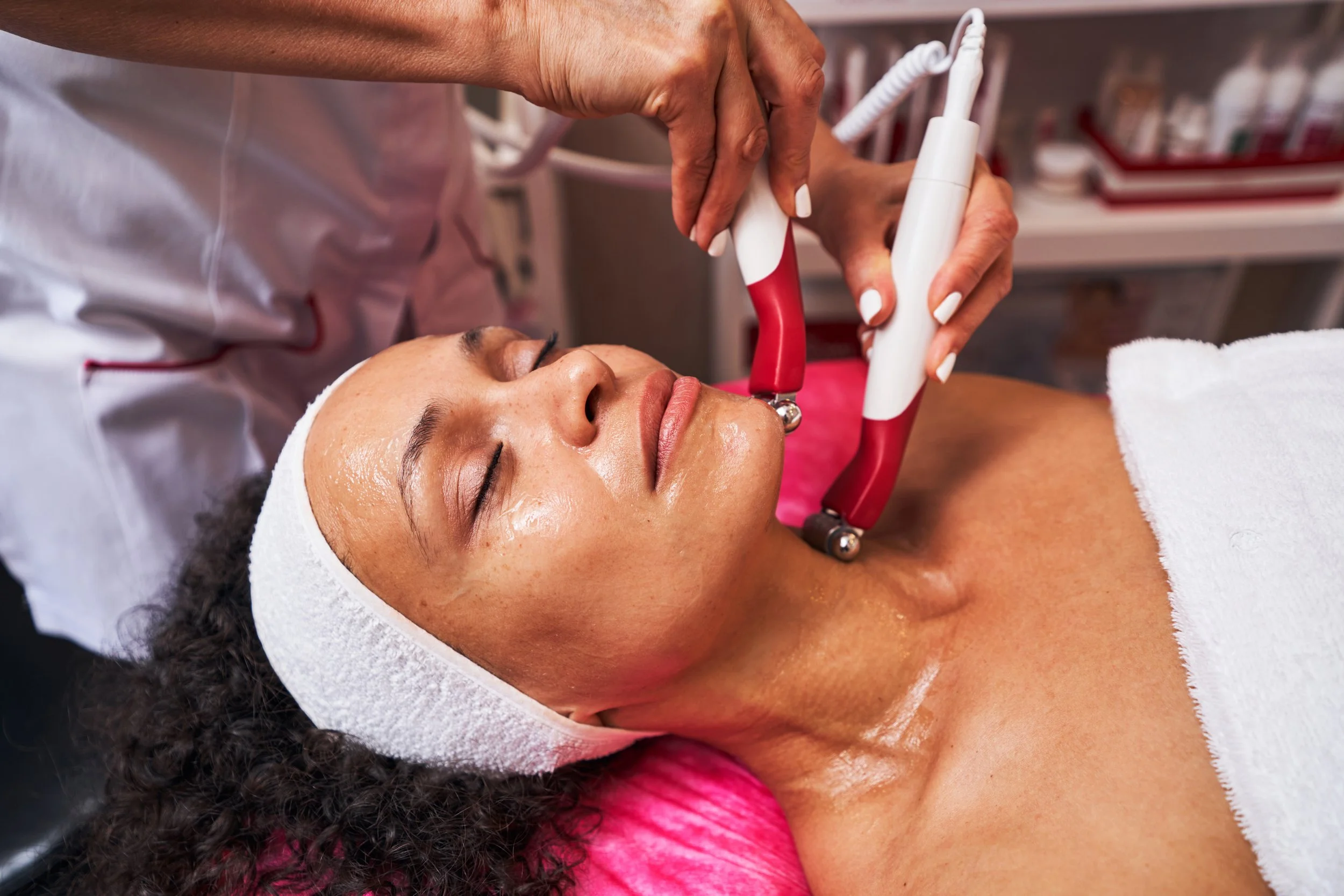
Nobody walks in asking for facial balancing. They ask for lips or the hollows under their eyes. Or a jawline that has softened. The term exists because the feature bothering you is often not the one causing the problem. A chin that sits slightly back makes a jawline look heavy and lips look larger than they are. Flattened cheeks drop the tissue below them and deepen the folds beside the mouth.
Treat the complaint on its own and you can end up with a face that has one very good feature and worse proportions than it started with. Romana Amjad (MS, NP-BC) assesses the whole face before recommending anything, and that assessment is the useful part.
What non-surgical facial balancing assesses
Proportion is measured against your own face rather than an ideal. There is no template being applied. The assessment covers the relationship between thirds, meaning forehead to brow, brow to base of nose, and nose to chin. It looks at your profile from the side, where a recessed chin or a flat midface shows most clearly. It checks how features sit relative to each other from the front, and it accounts for asymmetry, which everyone has.
Movement matters too. A face at rest tells you about structure. A face talking and smiling tells you where muscle is pulling, and that decides whether a problem needs volume, a neuromodulator, or nothing at all. The output is a plan with an order to it, not a list of everything that could theoretically be treated.
Facial balancing treatment areas
Some areas do structural work and others refine. Which ones you need depends entirely on what the assessment finds, and most plans use three or four rather than all of them.
Structural areas
Cheeks and midface are the usual foundation, because volume here supports everything below it. The chin is the most underrated area in aesthetics and often the one that changes a profile most, particularly in patients who have always disliked their side view without knowing why. Jawline definition follows from the chin rather than being treated separately.
Refining areas
Lips are treated in proportion to the chin and the lower face, which is why a good injector may want to build the chin first. Temples hollow with age and pull the upper face inward. The area under the eye can be addressed, though it is the most technically demanding on the face and often improves on its own once the cheek is supported.
How a facial balancing plan is built
Facial balancing is a strategy rather than a product, and it usually draws on more than one. Dermal filler does the structural work, with firmer gels in the chin, jaw and cheeks and softer ones in the lips. Botox handles anything caused by muscle rather than volume, including a chin that dimples, a jaw that clenches, or a downturned mouth corner. Skin quality treatments sit alongside both, since good proportions on poor skin still read as tired.
Sequencing is the part that separates a plan from a shopping list. Structure comes before refinement, which is why a patient who arrived asking about lips may be advised to treat the chin at the first visit and the lips at the second. Budget shapes it as well, and there is no clinical reason to do everything at once. Most plans run across two or three appointments over six to twelve months.
How long facial balancing lasts
Expect swelling for two to three days and the possibility of bruising for up to a week. Stay upright and skip the gym for twenty-four hours, avoid heat and pressure on treated areas, and sleep on your back for a few nights.
Judging the result early is the most common mistake. Swelling exaggerates volume in the first week, and the face settles into its actual proportions somewhere around week two. Photographs at that point are worth more than a mirror.
Longevity varies by area and by product. Structural filler in the cheeks and jaw holds twelve to twenty-four months. Lips run six to twelve, since they move constantly. Botox needs repeating every three to four months.
Most patients settle into maintenance every twelve to eighteen months once the initial plan is complete, and maintenance usually takes less product than the original build.
What facial balancing costs in Clifton Park, NY
Pricing follows syringes rather than areas. Filler in this market runs roughly $650 to $900 per syringe, and Botox is charged separately per unit.
A focused plan of three to five syringes generally lands between $2,000 and $4,500. A comprehensive plan of six to ten, sometimes marketed as a liquid facelift, runs higher. National figures reach $12,000 at the top, though those numbers come from Manhattan and comparable markets and sit well above upstate pricing.
Staging spreads it. Two or three appointments across a year cost the same in total and produce a better result than compressing everything into one visit. You will get a written plan with a syringe count and a total at your first appointment.
Why we stage facial balancing
Romana Amjad, MS, NP-BC is a board-certified nurse practitioner who came to medical aesthetics from critical care. Her approach to balancing is conservative by design.
The failure mode in this category is not a bad injection. It is a series of reasonable-looking individual treatments that add up to a face which reads as treated. That happens when each visit is planned in isolation and nobody is watching the total.
Staging avoids it, because you see how the face responds to structure before deciding what else it needs. Some patients find the second appointment is smaller than planned. That is a good outcome, not lost revenue.
Frequently Asked Questions
Is facial balancing the same as a liquid facelift?
They overlap. Liquid facelift usually describes a larger volume of filler placed in one or two sessions for a lifting effect. Facial balancing describes the planning approach, which may involve far less product. The terms get used interchangeably in marketing.
Will I look overdone?
Not if the plan is staged and the totals are tracked. The overfilled look almost always comes from volume accumulated over years of single-area treatments rather than from one aggressive session.
Can I do it in stages?
Yes, and most patients should. Splitting a plan across two or three appointments costs the same, spreads the expense, and gives you a decision point between each one.
Do I need Botox as well as filler?
Sometimes. It depends on whether what bothers you is caused by lost volume or by muscle pulling. The assessment answers that, and plenty of plans use only one of the two.
What if I only want my lips done?
That is a legitimate request and we will do it. You will still get an honest opinion first about whether lips alone will give you what you are after, particularly if your chin is the reason they look the way they do.
