

PRP Hair Restoration in Clifton Park, NY
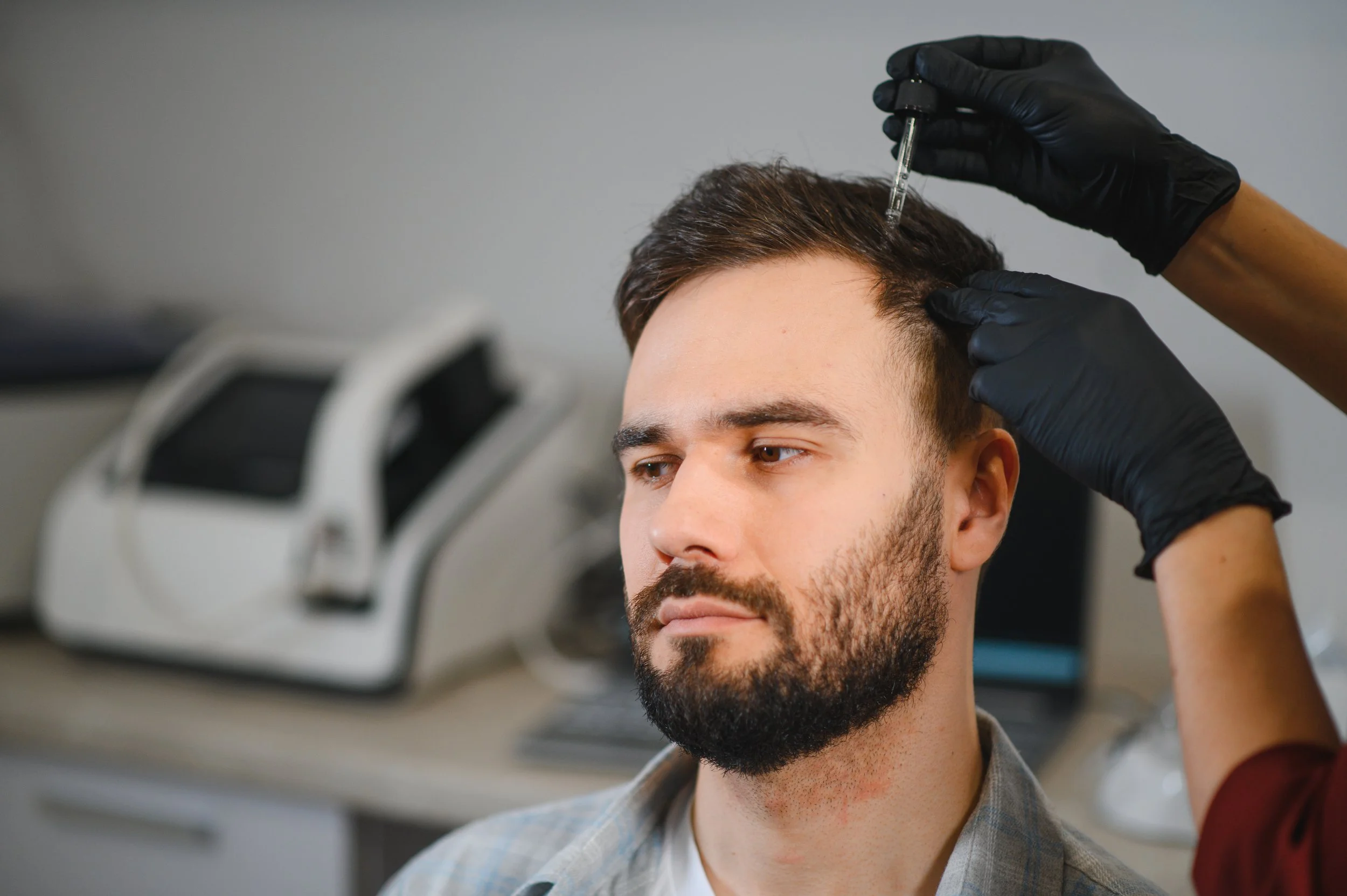
PRP is the only treatment here that begins with a blood draw. Roughly a vial, the same as a routine lab test, spun in a centrifuge for about ten minutes and injected into your scalp before you leave.
It is also the treatment where honesty matters most, because hair loss attracts more failed products than anything else in aesthetics. PRP is not a cure and the FDA has not approved it for hair loss. What the published evidence does support is slower loss and measurable gains in density for people who start early enough.
Romana Amjad (MS, NP-BC) will tell you at a scalp assessment whether you are likely to be one of them.
Where the platelets come from, and what they do
Blood separates by density when spun. Red cells sink, plasma rises, and a narrow band of concentrated platelets sits between them. That band is what gets drawn off and injected.
Platelets exist to repair injury, and they carry the signalling proteins that coordinate it. Concentrating them several times above their normal level puts an unusually strong repair signal directly around the follicle.
The proposed effect is a longer growth phase before the hair sheds, supported by better blood supply to the follicle, with some reversal of the miniaturization that turns thick hairs into fine ones.
Worth knowing before you compare clinics: there is no standard protocol. Spin speed, platelet concentration, injection volume and spacing all vary between practices, and that variation is a large part of why published results differ so much.
Which kinds of hair loss PRP can help
The single factor that predicts whether PRP works is whether the follicle is still alive. Everything else follows from that.
Androgenetic hair loss, the pattern kind, has the strongest evidence behind it. In women that usually shows as a widening part and thinning across the crown. In men it starts at the temples and the vertex. Follicles here are shrinking rather than gone, which is exactly the situation PRP is suited to.
Telogen effluvium is diffuse shedding with a trigger behind it. Childbirth, illness, surgery, severe stress and rapid weight loss are the usual ones. It often resolves on its own within six to nine months. Treating it before you have identified the trigger is money spent on a problem that was going to correct itself.
Scarring alopecia is different again. Once the follicle has been replaced by fibrous tissue there is nothing left to stimulate, and no injection changes that. The same applies to areas that have been smooth for years.
Inside a PRP session
Before anything is drawn, Romana will review your platelet history, medications and thyroid or iron testing if it has been done. Blood thinners, platelet disorders, active scalp infection and pregnancy all rule treatment out for now. Anti-inflammatories such as ibuprofen suppress platelet function, so stop those several days ahead, and eat and drink normally before you come in.
The draw takes a minute. While the centrifuge runs, numbing cream goes on the scalp, and cold air or a vibration device helps during the injections themselves.
The plasma is placed in a grid across the thinning areas, roughly a centimetre apart, into the layer where follicles sit. It is a series of quick stings rather than sustained pain. Some areas are treated with microneedling instead, which distributes product across a broader zone.
Expect around an hour. Then the scalp feels tender and tight for a few hours. Leave it unwashed until the evening. Then skip the gym for a day and stay off anti-inflammatories for two days after that.
The timeline, and how many sessions
An initial course is usually three to four sessions spaced four to six weeks apart, followed by maintenance every three to six months.
Shedding sometimes increases in the first few weeks. That is unwelcome and it is not a failure, since follicles pushed into a new growth cycle release the old hair first.
Reduced shedding is the earliest real signal, generally around month two or three. Visible density follows between four and six months. Judging the result before then is judging it too early, which is why baseline photographs matter more with PRP than with almost anything else we do.
Results are maintained rather than banked. Stop treating, and the underlying process resumes.
What PRP hair restoration costs in the Capital Region
Single sessions run $400 to $1,500 nationally. New York City practices sit at the top of that range, and upstate pricing falls below it.
An initial course of three is the number that matters, and packages nationally run $1,200 to $3,500. Maintenance visits fall between $400 and $1,200. Compare the course price rather than the per-session rate, since a cheap session in a plan that needs six of them is not cheap.
Insurance does not cover PRP for hair loss, though FSA and HSA funds often can be used. You will get a full course price at your first visit, before committing to anything.
Why patients choose Iridium Aesthetics for PRP
Romana Amjad is a board-certified nurse practitioner who came to medical aesthetics from critical care. With hair loss, the clinical value sits in the assessment rather than the injecting.
Thinning has many causes, and several of them are medical. Thyroid dysfunction, low ferritin, hormonal shifts and medication side effects all present as hair loss and none of them respond to platelets. Being told to get bloodwork before starting a course is a better outcome than being sold one.
Frequently Asked Questions
Is PRP approved by the FDA for hair loss?
No. The centrifuge systems used to prepare PRP are FDA-cleared devices. PRP for hair restoration itself is an off-label use. That is legal and common in medicine. You should just hear it now rather than find out later. Any clinic describing it as FDA-approved for hair is describing it wrongly.
I shed more in the autumn. Is that hair loss?
Probably not. Seasonal shedding is well documented. It peaks in late summer and autumn and settles by winter. Hair loss worth treating shows up as reduced density over months rather than more hair in the drain for a few weeks.
Can I use PRP alongside minoxidil or finasteride?
Yes, and combining usually outperforms either alone. They work through different mechanisms, so there is no reason to choose. Bring the details of anything you already use.
Does it hurt?
The injections sting, particularly along the hairline where skin is thinner. Numbing cream and cold air make it manageable, and the whole injecting phase lasts around fifteen minutes.
What happens if I stop?
Density gradually returns toward where it was heading before treatment. PRP interrupts a process rather than ending it, which is why maintenance visits are part of the plan rather than an upsell.
